Article: Ken Hunt - A Life in Line and Steel

Ken Hunt - A Life in Line and Steel
Ken Hunt’s is the story of a boy born into war-time austerity who grew up with nothing much in the way of comfort or luxury, except an imagination, a pencil, and an eye for detail. It is also the story of how one quiet, determined craftsman turned the anonymous trade of gun engraving into a recognised art form, creating a visual language that now runs through three generations of his family.
From the old couple’s butterfly collection in Bedfordshire to Broadwick Street in Soho, from production-line Purdeys to gold-smothered exhibition pieces, from best London guns to silver bracelets on a wrist, this is the arc of that journey.
His Early Life: War, Austerity and a Butterfly Collection
Ken’s artistic life begins long before he ever touched steel.
He was born before the Second World War, raised into a Britain of air-raid sirens, ration books and blackout curtains. One of his earliest memories is of being evacuated to Bedfordshire as a very young child. There, in a modest house, an elderly couple took him in.
Two details from that house lodged in his memory and never left:
- The classical music constantly playing in the background.
- The old man’s butterfly collection, carefully pinned, labelled and preserved.
The combination of those two things, pattern and delicacy, rhythm and structure, is not hard to see later in his work. At the time, of course, he had no language for it. He was simply a little boy fascinated by colour, form and order at a time when the wider world was anything but orderly.
Back home there was no television, paper was scarce, and every part of life was governed by rationing. Entertainment was the radio, the Saturday morning cinema, and whatever you could make with your hands. Ken took to drawing. He drew horses inspired by Westerns and adventure films, re-imagined scenes from the cinema, and filled whatever scraps of paper he could find.
Nobody else in the family was artistic. There were no painters, no designers, no engravers. This was not a craft handed down; it was something he simply couldn’t stop doing.
A small classroom drama helped crystallise that instinct. At junior school, in Mrs Brown’s class, there was another boy, Kenny, who became Ken’s first artistic rival. When Kenny’s drawing was pinned to the wall, Ken remembers the sharp mixture of admiration and competitiveness: “Kenny is a good artist.”
Mrs Brown later asked the children to copy a horse’s head. Ken drew his, and this time it was his picture that went up on the wall.
That tiny moment, a teacher’s choice of which drawing to pin up, mattered. It told a quiet, observant child from a non-artistic family that perhaps he had something worth pursuing.
Discipline, Determination and the Need to Prove Something
When you talk to Ken about why he always tackled the hardest things first, he doesn’t romanticise it. He reaches for something more psychological.
He grew up under the shadow of war and its aftermath. His teachers were often ex-servicemen, men who had seen the First World War and returned to classrooms with military habits: drills in the playground, strict discipline, clear hierarchies. You were “pulled up” for falling short. You followed orders. You did what you were told.
At home, Ken often felt slightly overlooked, as if his brothers or other boys were the ones being praised. That stung. It left him with a powerful internal drive:
I’ll show you. I’m going to be good at something. You’ll notice me then.
That craving, for the pat on the back that never quite came, turned into a philosophy of work: always try the difficult thing first. If you can conquer what’s genuinely hard, the rest will follow. That attitude would become a defining feature of his apprenticeship and the reason he stayed when others walked away.
Two Doors: Garage or Gunmaker
In 1950, aged fifteen and about to leave secondary modern school, Ken met the careers officer. The choice offered to him was stark and simple:
- An apprenticeship at a Garards, the top London Silversmith
- An apprenticeship with a gunmaker
Living on the Queen’s Park estate in Paddington, he knew of Holland & Holland on the Harrow Road. He had seen the gun shop. He had seen weapons in museums, some of them decorated, but had no idea that there was such a thing as a professional gun engraver.
He went, with his mother, to Purdey’s premises near Paddington and Iron Gate. They put a finely engraved gun in his hands, a piece decorated by the legendary Harry Kell, and invited him to look at the scrollwork.
His reaction was honest and very fifteen-years-old:
“I don’t think I could do that. It’s tricky work.”
They asked him to draw instead. He was given a large gold-inlaid gun as reference and told to make a drawing from it. He did. They saw enough.
“You’ve got some capability” was the gist. And that was that.
Into the Workshop: Broadwick Street and a 19th-Century World
While the arrangements were finalised, Ken spent a couple of months in the Purdey factory under Donald O’Brien, who handled polishing and casing. There he absorbed the atmosphere: the men, the work, the quiet sense that this was a trade of many invisible hands.
Then came the move that would shape the rest of his life: across to 45 Broadwick Street, Soho, Harry Kell’s workshop.
This was no bright modern studio. It was a time capsule.
- The ground floor was a silversmith’s, where you could hear men cutting and hammering all day.
- Up a set of stairs was the engraving room: a rickety little space with no central heating, lit by daylight from the window and a handful of 25–75 volt bulbs from the ceiling once it grew dark.
- Tools were sharpened on a manually operated grindstone; there were no microscopes, no optivisors, no electric handpieces.
The men inside were living links to an earlier era of London gunmaking:
- Harry Kell, nearing seventy, the master of fine English gun engraving.
- Jim Jones, in his late seventies or early eighties, who had started in engraving at thirteen and spent his whole life cutting only small scroll and flowers.
- Bill Smith, moustached, bespectacled, devout, and quietly watchful.
The bench arrangements mirrored those of the jewellery trade. A plank, a “packing board”, jutted from the bench with a notch to hold a little clamp. Into that clamp went lockplates, trigger guards, top straps and the rest. The engraver sat with the workpiece about a foot or more away from his eyes, utterly dependent on naked eyesight.
Compare that with today’s engravers under microscopes and surgical LED lighting, and you begin to appreciate the environment in which Ken’s style was forged.

Commercial Reality and the Need for Speed
Kell took Ken on because the old hands were aging and the firm’s future depended on throughput. They still charged pre-war prices for engraving, £8 for a small scroll, £10–12 for a large scroll, even as costs rose. The only way to survive was speed.
Kell wanted Ken to become a “hacking” engraver: someone who could turn out commercial guns fast enough to keep the workshop afloat. There were murmurs of bankruptcy. Orders needed filling.
In the traditional London system, a gun would move through the workshop in sections:
- One engraver would do the pins and borders,
- another the flowers,
- another the top strap,
- another the trigger guard.
A gun might arrive on a Monday and leave by Wednesday. Time spent was money lost. Finely shaded British game scenes and deep baroque scrolls were luxuries; bread-and-butter work was tight scroll, cut quickly and consistently.
Ken understood all this. But his nature was not to lower his sights to fit the job. He wanted to do better, to see how far he could push both technique and design without breaking the commercial realities that fed everyone.
The Apprentice Who Stayed
Many apprentices came to Kell’s workshop. Most didn’t last.
They saw the cold, the grindstone, the endless small scroll in poor light and moved on to easier or more lucrative work. Ken did the opposite. He stayed late, used a little stove in the corner to heat up the dinner his mother had sent, then went straight back to practice plates and experiments.
Kell noticed.
One day, a letter arrived from an American serviceman for whom Kell had done work during the war, badges, tokens, lighters, things to brighten drab khaki life. The man wrote asking after the shop and whether Kell had ever taken on that promising apprentice he’d mentioned.
Reading the letter, Kell, not a man given to displays of emotion, grew tearful. He was, Ken later learned, speaking about him. After years of false starts with other boys, here was one who wasn’t “a dead horse”. Here was one who had both discipline and passion.
That combination, discipline from the world he grew up in, passion from whatever mysterious inner spark drove him, would define Ken’s entire career.

Museums, Armouries and a Self-Taught Eye
While his hands were being educated on Broadwick Street, his eyes were educated in London’s museums.
Saturday after Saturday he would stand in front of display cases at the Victoria and Albert Museum, the British Museum, the Wallace Collection, and the Tower Armouries, studying metalwork, armour, jewellery and decorated weapons.
Guards watched him closely, wondering what this young man intended as he leaned close to the glass for so long that he looked like he might smash it. What he was doing, in fact, was reverse engineering: analysing how gold was laid, how patterns were formed, how shading worked.
He discovered Roman jewellery beaten hollow and filled with gypsum or sand to stretch scarce gold as far as possible. He saw how, after Rome’s conquests, gold became more plentiful and jewellery became heavier, more demonstrative of wealth and power.
He learned about damascening, the technique of inlaying fine gold or silver into a steel surface, from Oriental arms and armour: Turkish, Persian, Indo-Persian, and later European and Japanese interpretations of the same idea. He noticed how a tiny amount of gold wire, drawn out fine enough, could cover a vast surface if used cleverly.
All of this filtered back into his engraving bench. Where Kell had been taught to sink thick gold deeply into steel like an iceberg, two-thirds hidden below the surface, Ken began thinking in terms of surface coverage, visual impact and efficient use of precious metal.
Experimentation: Acid, Alloys and Backgrounds
Long before most British engravers had considered hybrid techniques, Ken was experimenting. An antique-dealer friend asked if he could revive an old gun using matched ornamentation; another challenge was how to clear background quickly without endless hand-cutting.
Remember: this is the era before off-the-shelf plastic tubs, ready-made resist paints, or safe, purpose-made jewellery kits. Ken bought nitric acid from an oil shop in Carnaby Street and mixed his own resist from beeswax and other ingredients, painting it on with a pen.
He learned, sometimes the hard way, about acid strength and timing. A mix of four parts water to one part acid might bite backgrounds quickly enough to be useful, but too strong a solution could pit the steel in ways that required painstaking repair. He discovered that older steels, with their particular mixtures of iron and alloy, responded quite differently to modern steels when etched.
These were not trivial experiments. A misjudged plate might mean hours of re-work. But Ken’s view was simple: if you can solve the difficult problem first, everything else is easier.
From Production Scroll to Personal Style
In the 1950s, information about foreign engraving was scarce. There was no internet, no Instagram feeds of Italian bulino. Ken had a 1953 Gun Digest and a handful of magazines, one of which showed Austrian engraving and an extraordinary gold-rose on a gun given to a British officer.
Those images burned into his mind. He also saw a particular vine-leaf pattern on a gun in Germany that fascinated him. He took the shape and, over time, developed his own version, a flexible motif that could be scaled up or down across a gun so it always looked natural, like leaves of different sizes on a real plant.
The vine leaf solved several problems at once:
- It was visually rich, giving an air of luxury.
- It was adaptable, filling large areas gracefully and small spaces with equal ease.
- It supported his obsession with speed, allowing him to cover ground without losing finesse.
At the same time, he refined his scrollwork, shading and use of gold. Where Kell’s birds and animals sometimes reflected the limitations of Victorian reference books, lions with overlarge eyes copied from royal coats of arms, for example, Ken sought better sources, better anatomy, a more lifelike feel.
All of this contributed to the emergence of a recognisable “Ken Hunt handwriting”: the way a tendril flicks, the way shading runs, the interplay of scroll and leaf, his distinctive vine leaves. Other engravers, looking at a Holland & Holland, a Purdey or a Rigby, can read that “handwriting” instantly.
Name on the Lockplate, Even When It Wasn’t
For most of the 20th century, gun engraving was a silent craft. The maker’s name went on the lockplates; the engraver’s name stayed in the workshop ledger, if it was recorded at all.
Ken quietly broke that pattern.
Over decades, his work passed through the benches of James Purdey & Sons, Holland & Holland, John Rigby & Co., Westley Richards and other top-tier makers. He gravitated naturally towards commissions where there was room for narrative, for bolder gold work, for personal expression.
Collectors began to ask for “a gun engraved by Ken Hunt” rather than simply “a Purdey”. Auction houses started using his name in catalogues as a value-adding phrase. He has been described, more than once, as “the first ‘name’ engraver” in the English trade, a man whose signature, style and reputation carried weight independent of the maker.
By the time he retired from full-time gun engraving, he had engraved somewhere in the region of 2, 600 guns over more than sixty years. Many of those pieces now sit in major private collections and museums; some are still taken into the field by careful owners who understand they are carrying both a tool and a piece of living art.

Embellishing the Weapon: A Human Constant
One of Ken’s most insightful observations cuts straight to the heart of what he spent his life doing.
From the beginning of time, he says, every man has embellished his weapon.
Sometimes the embellishment is symbolic, marks of clan, rank or allegiance. Sometimes it is cultural, expressing myths, animals or patterns from a particular people. Sometimes it is practical, adding grip, texture or guidance. But it is always there: the instinct to make the object that keeps you alive into something that reflects who you are.
Swords, axes, shields, bows, spearheads, firearms, all of them, across cultures, gain ornament once basic function is assured. In many societies, a man was buried with his weapon. It had become part of him.
In that light, Ken sees his work not as “decoration” in a trivial sense, but as participation in a very old human story. By engraving a gun, or later by designing a bracelet or ring, he is helping someone make their chosen object truly theirs.
From Gun to Jewellery: The Line Continues
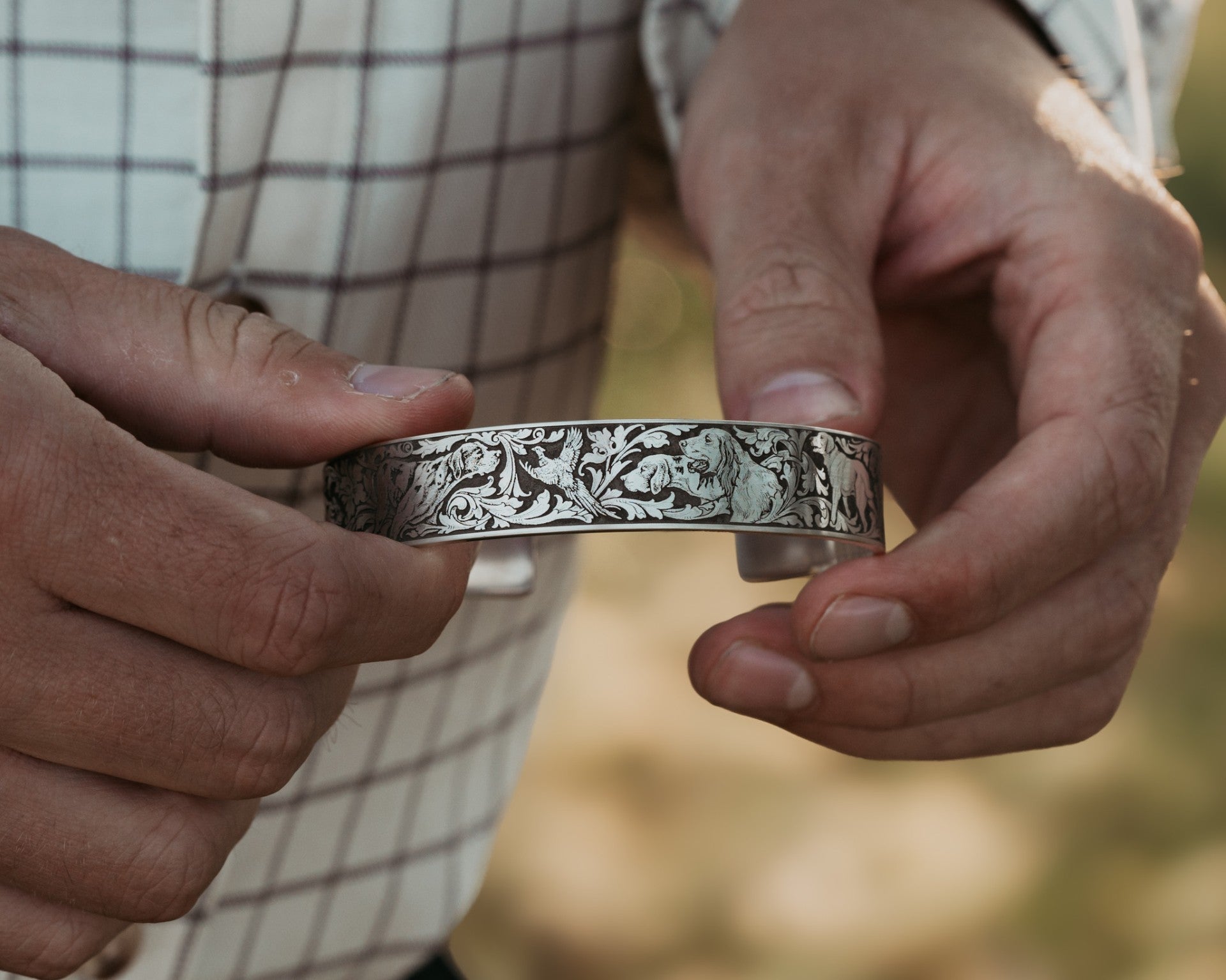
The same logic underpins the later chapter of his career: the transition from gun engraving to jewellery designed in collaboration with his grandson Charlie, under the banner of Ken Hunt Jewellery.
If a best English shotgun or rifle is out of reach, or destined for a safe, rather than a field, a bracelet, ring, pendant or pair of cufflinks offers another way of carrying that heritage, that language of line and leaf, into daily life.
The motifs are unmistakably his:
- Scrolls that recall the flanks of a Purdey or a Holland.
- Vine leaves, roses, oak leaves and acorns, shaped by decades of cutting steel.
- Occasional nods to butterflies or other personal symbols tied back to his earliest memories.
These pieces are designed to be worn, not worshipped behind glass. Ken himself is clear: engraving, historically, is for use. A gun should be shot. A bracelet should be lived in. His jewellery is made robust enough to carry on that tradition of “embellished weapon”, translated to the modern world as “embellished self”.
Charlie runs the business and brings his own sensibilities to branding, customer experience and modern production. Ken continues to design, drawing and sketching patterns that are then translated into silver and gold. In this way, his line, both figurative and literal, carries over into a third generation.
Family of Engravers: Three Generations, One Language
Ken’s legacy runs not only through collectors’ safes and museum cabinets, but through his own family.
- His daughter Alison became, as far as records show, one of the first women to work professionally as a gun engraver in the British trade, before stepping back to raise a family.
- His son Marcus followed him onto the bench, developing his own style while remaining rooted in the traditions he learned by watching his father’s work. A one-off Alfred Dunhill cigar cutter decorated with deep scroll and gold inlay is a good example of how these techniques can jump from gunrooms to gentlemen’s accessories.
- His grandson Charlie bridges engraving and contemporary jewellery, allowing the designs to live not just on heirloom guns but on wrists, fingers and cuffs.
Each has their own “hand”, their own touch. Ken can glance at a piece and tell whether it’s his, Marcus’s, or someone else’s. Like handwriting, certain strokes, flourishes and habits never quite disappear.

A Teacher by Example
Even after stepping back from full-bore gun work, Ken never stopped drawing, never stopped refining scrolls and leaf patterns on paper. In recent years he has shared more of his process through talks, demonstrations and informal tuition.
Young engravers speak of him as a “Grand Master”, not only because of his achievements, but because he is willing to share tips, stories and hard-won shortcuts. From how to sharpen a tool on a grindstone to how to read the structure of steel under acid, he passes on knowledge that might otherwise have vanished with one man.
And the trade has, in its own reserved way, recognised him. He has received a Master Gunmakers Certificate and Lifetime Achievement Awards, formal acknowledgements that the boy who walked into Purdey at fifteen lived a life that tangibly shaped British gunmaking and engraving.
A Living Line
If you strip away the romance and the auction prices, what remains is a man and a line.
A line drawn in pencil on scrap paper by a boy in a rationed kitchen.
A line cut in steel under poor light in a cold Soho workshop.
A line of gold laid onto a lockplate so thin and precise it will outlast us all.
A line of heritage: from Kell to Hunt, from gun to jewellery, from grandfather to grandson.
Ken Hunt’s story is not just about guns, or gold, or scrolls. It is about how a quiet, determined human being takes the materials given to him, war, austerity, limited options, a tradesman’s bench, and turns them into something that outlives him.
You can see that in a Purdey with his vine leaves, in a Holland with his gold birds, in a bracelet bearing his scroll. You can see it in the way other engravers look at his work and immediately recognise the hand. You can see it in the fact that people who will never shoulder a best London gun still choose to wear his patterns against their skin.
A boy stared at a butterfly collection and listened to classical music in a stranger’s house during the war. A man spent a lifetime turning that same sensitivity to pattern and rhythm into steel and gold. And now, every time someone notices a tiny flourish on a gun or a bracelet and smiles, that line, Ken’s line, continues.

Leave a comment
This site is protected by hCaptcha and the hCaptcha Privacy Policy and Terms of Service apply.